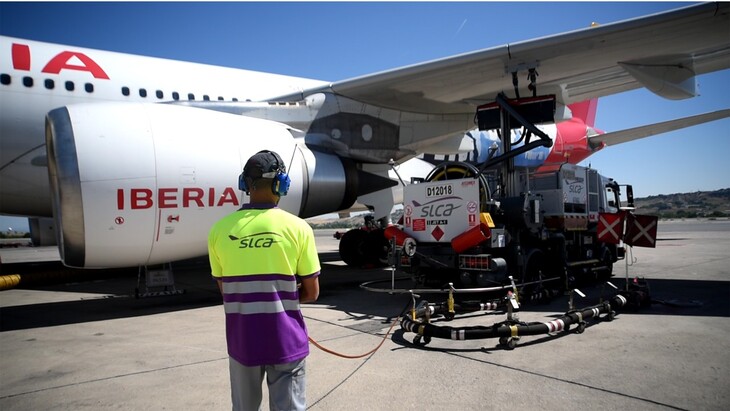
Iberia has signed an agreement with the American renewable chemicals and advanced biofuels provider Gevo to acquire 110.700 tonnes of sustainable aviation fuel (SAF) over five years (22.000 tonnes per year), enough to reduce CO2 emissions by up to 353.000 tonnes (the equivalent of taking over 22,800 cars off the roads). The Spanish airline will start powering its flights from Los Angeles and San Francisco with 45% of SAF from 2028.
As part of IAG, Iberia has committed to achieving net zero carbon emissions by 2050 and to powering 10% of its flights using sustainable aviation fuel (SAF) by 2030.
Teresa Parejo, Sustainability Director at Iberia, commented on this agreement: “SAF is the best solution to advance in the decarbonisation of the aviation sector, while other technologies can be developed. This agreement with Gevo is part of our commitment to achieving net zero emissions by 2050, and part of the investment being made by the entire aviation sector toward the industry´s greener transition. This is a global challenge that must be addressed globally and requires as much public-private collaboration as possible”.
Dr. Patrick R. Gruber, Gevo’s Chief Executive Officer, said: “We are excited to welcome another member of the IAG to Gevo’s SAF customer roster. The growth of the offtake agreements that we are seeing for SAF reinforces that airlines are ready to make an immediate impact and reduce their carbon intensity. With these commitments, we have no doubt that Gevo can help them achieve their sustainability targets”.
First long-haul flights using biofuel produced from waste in Spain
In June, to commemorate its inaugural flights to Dallas, San Francisco and Washington DC, Iberia, in partnership with Repsol, operated its first long-haul flights using biofuel produced in Spain from biological waste. In these three flights, Iberia reduced the CO2 emissions by 125 tonnes, thanks to the improved efficiency of the aircraft used (Airbus A330-200) and the 2 per cent use of sustainable biofuel.
The decarbonisation of the aviation sector
Iberia has put the decarbonisation of the aviation sector at the heart of the company with the development of a sustainability strategy, which is based in four pillars:
Social and environmental sustainability is also one of the pillars of Iberia's strategic plan for the next three years - Next Chapter - which, with the commitment of its employees, will allow the airline to ensure its financial strength, position itself as the airline of choice for travellers, strengthen its position in the Madrid hub, and make progress in the green transition of the aviation sector.